


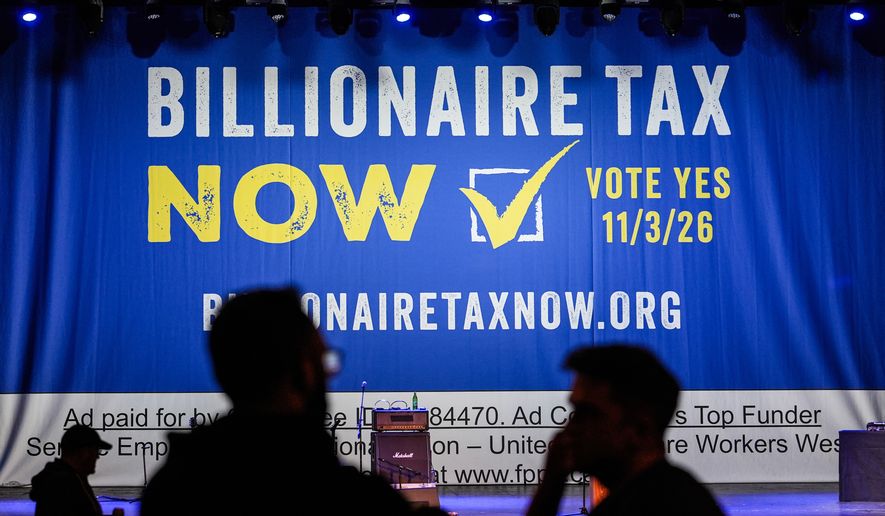

California voters, in an unprecedented showdown over economic inequality, will decide in November the fate of the 2026 Billionaires Tax Act.
The landmark ballot initiative will ask Californians whether to impose a one-time, 5% levy on taxpayers and trusts with assets exceeding $1 billion, including business interests, securities, cryptocurrency, vehicles, artwork and intellectual property.
The money would be used mostly to fund the state’s Medicaid program, which proponents say has been hurt by federal cuts under the Trump administration and is poised to lose $19 billion in annual federal funding.
A smaller portion of the funds would be dedicated to public education.
More than 900,000 voters are estimated to have signed the petition to qualify the tax for the November ballot, signaling mounting public frustration over the wealth gap as everyday Americans struggle against inflation.
If the ballot measure succeeds, supporters are ready to test other states with similar initiatives while Democratic lawmakers prepare federal wealth tax legislation.
“If this passes, it can be a model for states around the country to do what’s right,” said Our Revolution, a democratic socialist political action group.
Several states, including Washington, Maryland, Massachusetts and Minnesota, have imposed taxes on millionaires or are considering similar legislation.
No state has gone as far as California’s ballot initiative, which, if passed, would impose the tax on billionaires retroactively to Jan. 1, 2026, forcing even those who have moved out of the state in the past year to pay the government a significant portion of their wealth.
The tax would bring in “tens of billions of dollars” over several years beginning in 2027, the state’s Legislative Analyst’s Office estimated.
A poll taken earlier this year by The Economist and YouGov found 80% of Americans believe the wealth gap between the rich and the poor is either “a very big” or “somewhat big” problem. In the same poll, 62% said billionaires are not taxed enough, and nearly 60% said the government “should try to reduce wealth inequality.”
When broken down by party, it is mostly Democrats who want to tax billionaires, which aligns with efforts by California and other blue states to tax their richest residents. The anti-billionaire sentiment is echoed on Capitol Hill among leading liberal lawmakers who are pitching national wealth taxes.
Sen. Bernard Sanders, Vermont independent, has pounced on public discontent with billionaires.
Mr. Sanders introduced a wealth tax in March that would tax the nation’s 938 billionaires at a 5% annual rate.
The money would be spent, in part, on direct payments of $3,000 “to every man, woman and child” in households earning $150,000 or less. It would amount to a $12,000 payment for a family of four, the democratic socialist said.
“In a democratic society, we cannot tolerate 60% of our people living paycheck to paycheck — struggling to pay for housing, food and healthcare — while 938 billionaires have become $1.5 trillion richer,” Mr. Sanders said.
A half-dozen of California’s estimated 200 billionaires fled the state before the Jan. 1 cutoff, taking with them an estimated $700 billion in wealth, which will cut estimated tax revenue by more than $25 billion, according to the National Taxpayers Union Foundation.
More are likely to flee, the National Taxpayers Union Foundation said. “Concerned billionaires who missed the January 1 deadline still have a strong incentive to get out of the state as soon as possible, as a court decision striking down the retroactivity provision could wipe away tax bills from those who leave soon,” said Andrew Wilford, director of state policy at the National Taxpayers Union Foundation.
California Gov. Gavin Newsom and both candidates running to replace him, Democrat Xavier Becerra and Republican Steve Hilton, oppose the tax, citing concerns it will hurt the state economy.
The healthcare union that filed the ballot initiative has brushed aside those concerns as overblown.
The SEIU United Healthcare Workers West estimated the tax would generate $100 billion and that most billionaires would not bolt from California. Even if every one of them left the state, UC Berkeley economists Emmanuel Saez and Gabriel Zucman wrote in a May 26 New York Times op-ed, the one-time “trailblazing wealth tax” would make up for the loss of other tax revenue for the next 25 years because billionaires currently pay “such a low tax” on their net wealth.
David McCuan, a political science professor at Sonoma State University, said proponents of the billionaires tax want to avoid spending hundreds of millions of dollars to persuade voters to back the measure, which will be among up to 20 initiatives on the California ballot.
“Crowded ballot, crowded airwaves, voters being inundated,” he said. “There is some time to watch here on this measure.”
The Billionaire Tax Now Coalition, which includes the SEIU and other proponents, wrote to Mr. Newsom on June 18, offering a compromise: If he agrees to a 2% tax on billionaires, they will drop the ballot initiative.
Mr. Newsom rejected the deal, calling the tax a “poorly designed measure” that will harm funding for teachers, schools, clinics and public safety.
Contact the author


Please read our comment policy before commenting.