


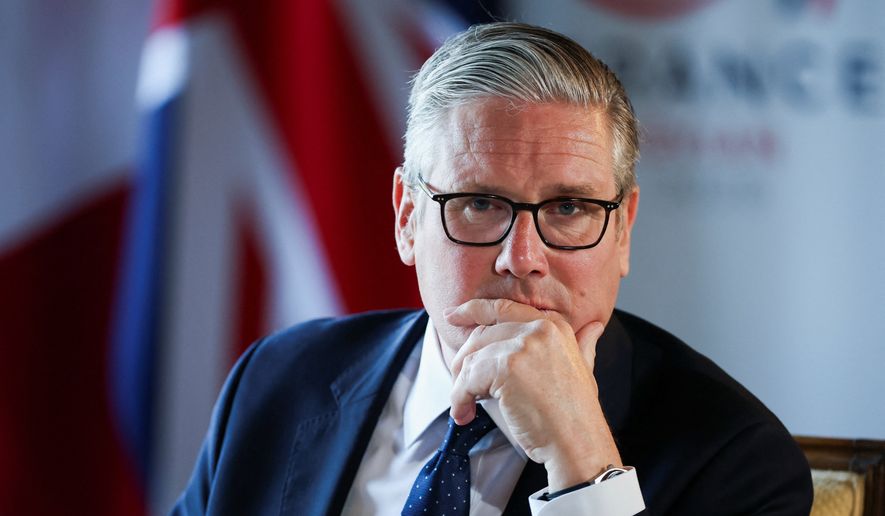

President Trump said Sunday that embattled British Prime Minister Keir Starmer will soon resign, citing growing discontent in the U.K. over Mr. Starmer’s immigration policies and refusal to grant new oil and gas exploration licenses in the North Sea.
Multiple British news outlets said Mr. Starmer could announce his resignation as early as Monday, after concluding that his position at No. 10 Downing Street was no longer tenable.
“He failed badly on two very important subjects — immigration and energy [Open North Sea Oil!]. I wish him well,” Mr. Trump said of the prime minister on Truth Social.
The relationship between the British and American leaders soured after Mr. Trump’s return to the White House. Tensions came to a head over Operation Epic Fury, the U.S. and Israeli campaign against Iran.
Mr. Starmer’s government initially blocked U.S. use of British military bases to launch attacks against Iran. He later relented and even considered sending the H.M.S. Prince of Wales aircraft carrier to the region.
“That’s OK, Prime Minister Starmer, we don’t need them any longer — but we will remember. We don’t need people that join wars after we’ve already won,” Mr. Trump said.
Mr. Starmer’s weakened political position reached a critical stage on Friday when Andy Burnham, a former mayor of Manchester and a Labour Party rival, won a seat in Parliament that would allow him to launch a formal leadership challenge.
Mr. Starmer spent the weekend at Chequers, the official country residence of the prime minister, where he discussed his future with his wife, Victoria, before making his final decision, according to The Observer newspaper.
A Labour Party official told The Observer that Mr. Starmer won’t leave abruptly but has acknowledged the political reality.
“Stopping chaos — as he rightly put it — is now not possible by staying, so that leaves one option,” said the official, who was described as being close to Mr. Starmer. “I think he has come to see it as the dutiful option to serve the country and the party.”
The Observer said Mr. Burnham will be sworn in as a member of Parliament on Monday and is due to meet the prime minister early in the week. His supporters said that he has secured the support of more than 201 Labor lawmakers.
“This is a critical number because it represents more than half the Parliamentary Labour Party and means that Starmer can no longer tell the King that he is able to command the confidence of the House of Commons,” The Observer reported.
Nigel Farage, leader of the U.K.’s right-of-center Reform Party, called Thursday’s election results “a dramatic, emphatic win” for Mr. Burnham, “with a vote share that nobody could quite see coming.”
He noted that Mr. Burnham had been popular with the public in Manchester, where he served as mayor for about nine years.
“What really happened here was ‘Vote Burnham, Get Starmer Out,’” Mr. Farage wrote on X after the election.
The June 11 resignation of now-former Defense Secretary John Healey has been described as a “hammer blow” to Mr. Starmer’s political standing that has pushed his leadership to the brink of collapse. He quit after a dispute with Mr. Starmer and the British Treasury over military funding.
Mr. Healey said the government’s proposed Defense Investment Plan fell short of the resources needed to protect the U.K. amid escalating global threats.
Unlike other more factional political figures, Mr. Healey was widely respected in government, with even Conservative leader Kemi Badenoch saying he did the “honorable thing” by stepping down.
“I am glad that he [Mr. Healey] agrees with me that we need to put more money in defense,” Ms. Badenoch told the U.K.’s SkyNews.
Contact the author


Please read our comment policy before commenting.